Explainer: Did the Paris Climate Agreement work?
The RSS Climate Change Task Force has produced a series of explainers to help people understand the statistics and data underpinning our understanding of climate change. This explainer looks at the 2015 Paris Agreement and how we can judge whether the agreement worked.
1. What is the Paris Agreement?
The Paris Climate Agreement was adopted by consensus by 195 nations in 2015. Its goal was to keep the increase in global mean temperature from pre-industrial levels to well below 2°C by 2100, with a target of 1.5°C. To achieve this, each country committed to reducing its own carbon emissions, resulting in a promised global average reduction of around 30% between 2015 and 2030.
Using data on carbon emissions for 2015–2024, it is now possible to probabilistically assess the changes in climate change prospects associated with post-2015 emissions.
2. How do we know whether the agreement worked or not?
The approach is statistical and consists of three main steps.
First, carbon emissions from each country are modelled. These can be broken down as the product of three factors:
Carbon Emissions = Population x GDP per capita x Carbon Intensity,
where Carbon Intensity is the amount of carbon emitted per unit of GDP. To lower carbon emissions, any one of the three factors can be reduced (assuming the other two remain constant). The focus in this explainer is on two elements of this equation, GDP per capita (which reflects affluence), and carbon intensity.
Second, the modelled carbon emissions are linked to temperature. The IPCC has published a close-to-linear empirical relationship between cumulative carbon emissions and global mean temperature change, which is used here.
Finally, using these two equations, it is possible to infer the distribution of temperature increase in 2100, using what is known as a Bayesian hierarchical model.
2. What is a Bayesian hierarchical model?
A Bayesian hierarchical model is, first of all, a statistical model: a mathematical way of describing how a quantity (here, carbon emissions) evolves, while accounting for its natural variability. It is hierarchical because it is built from several linked sub‑models, each informing the next. Finally, it is Bayesian because the parameters in the model are treated as uncertain, and our initial beliefs (called "priors") about their plausible values are updated as new data become available. Bayesian models are particularly useful to quantify the uncertainty of predictions.
Bayesian hierarchical models are used to model each of the three factors in the carbon emissions equation. Each factor is modelled separately for each country, with its own set of parameters. These parameters are treated as uncertain and are linked across countries, so that information is shared among them. As a result, estimates for any given country rely not only on the data for that country, but are also informed by patterns observed elsewhere. This is especially helpful when a country’s data are sparse or highly prone to inaccuracy.
4. What data do we have and how can we project those data into the future?
Data on population, GDP per capita, and carbon intensity for all countries are considered here up to 2024. Projections of population, GDP per capita, and carbon intensity out to 2100 are produced using a set of Bayesian hierarchical models. The temperature is then predicted based on its linear relationship with cumulative carbon emissions, as recommended by the IPCC’s 6th Assessment Report.
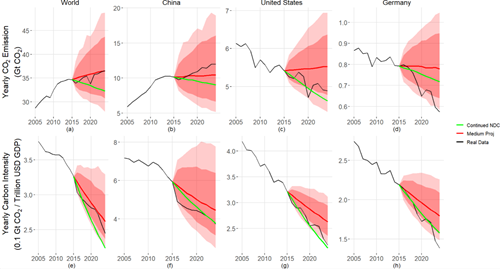 Figure 1. Probabilistic projections of CO2 emissions (top row) and carbon intensity for 2016-2024 (bottom row), based on data for 1960-2015: median projection (solid red line), 90% interval (dark shaded area), 99% interval (light shaded area), observed emissions (black line), and emissions needed to meet the nationally defined contribution target (green line). The columns correspond to the world, China, the United States, and Germany. Source: Jiang et al (2025, Figure 1).
5. Is the agreement working?
Carbon intensity has declined (i.e., fewer emissions per unit of GDP) substantially over the 2015-2024 period, but overall carbon emissions rose, due to the rapid rise in world GDP, which more than cancelled out the progress made.
A pre-Paris Agreement analysis, based on global emissions data from 1960 to 2015, had projected a median temperature increase of around 2.6°C by 2100. Using these new post-2015 carbon emissions data, together with the IPCC’s linear temperature relationship, showed that the projected temperature increase to 2100 declined slightly, to 2.4°C (solid red line in Figure 2). Meanwhile, the chance of staying below 2°C remained low, at 17%. However, the chance of the most catastrophic climate change, above 3°C, has gone down substantially, from 26% to 9%.
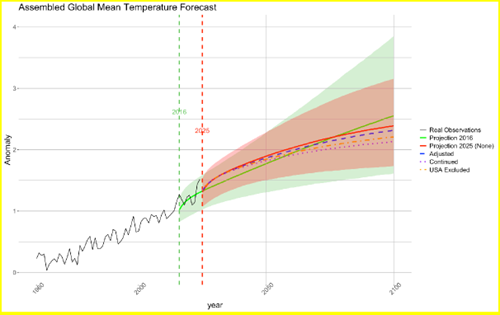
Figure 2. Probabilistic forecasts of global mean temperature increase by 2100: based on pre-Paris data up to 2015 (median in green line and 90% interval in green shaded area); made in 2025 (red line and pink shaded area); if all countries carry out their initial promises under the agreement up to 2030 and then revert to previous patterns (Adjusted: dashed blue); if all countries carry out their promises and continue to improve at the same rate thereafter (Continued: dotted purple); and based on the Continued assumption, but without the USA carrying out its promise (USA Excluded: orange dashed-dotted line). Source: Jiang et al (2025, Figure 7).
6. Is there any good news in these results?
The new data on carbon emissions result in a projected decrease of 64% in annual global emissions over the rest of the century. This contrasts with pre-2015 projections, which suggested that annual global emissions would remain roughly flat rather than decline. There has also been a large decrease in the uncertainty about future emissions.
Translating these projections into temperature, despite the substantial decrease in expected yearly emissions, the projected temperature increase to 2100 has decreased by only 0.2°C.
Since the Paris Agreement, projections of future temperature increase have declined slightly, but not enough to limit warming to the agreed target of 2°C. However, if all countries were to fulfil their existing promises under the agreement to 2030, and then to continue efforts at the same level, the projected increase would be 2.1°C, close to the agreed target.
7. Where can you find out more about this?
More details can be found in these publications:
Jiang, J., Shi, S. and Raftery, A.E., 2025.
Mitigation efforts to reduce carbon dioxide emissions and meet the Paris Agreement have been offset by economic growth. Communications Earth and Environment 6: 829.
Liu, P.R. and Raftery, A.E. 2021.
Country-based rate of emissions reductions should increase by 80% beyond nationally determined contributions to meet the 2 °C target: Communications Earth and Environment 2: 29.
Raftery, A.E., Zimmer, A., Frierson, D.M.W., Startz, R., and Liu, P. (2017).
Less Than 2 degrees C Warming by 2100 Unlikely. Nature Climate Change 7:637--641.