 About COSS
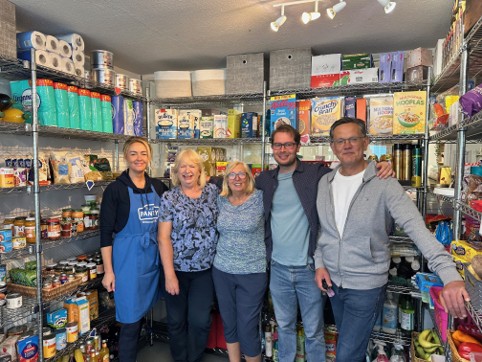
COSS was set up in 2002 to alleviate the effects of poverty and hardship in South West Edinburgh. The charity runs a busy "one stop" community hub providing a wide range of services including a foodbank, advice on various topics, poverty support, holiday programmes for children, and more1.
COSS were seeking data and advice to provide robust information to support fundraising and to enable them to focus their limited resources most effectively.
The request
COSS asked Statisticians for Society to find external statistics around poverty for Scotland, Edinburgh, and all the local areas COSS works in. They also asked for help around internal statistics, regarding how they gather, store, and analyse the data to reduce the amount of time spent on this.
The approach and results
Richard, the volunteer, first defined the areas served by COSS through two steps: 1) Identifying the
Intermediate Zones which matched to the COSS area names: Broomhouse, The Calders, Sighhill, and Westerhailes. From these Intermediate Zones, Richard identified the Data Zones in the most deprived 20% in the 2020 Scottish Index of Multiple
Deprivation. Richard then selected data to support funding bids was from these Data Zones: From the Scotland Index of Multiple Deprivation 2020. This included the population of each Zone and whether the Zone was in the most deprived 5%, 5-10% or 10-20%.
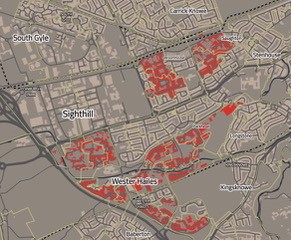
Areas served by COSS in the most deprived 20%, Scottish Index of Multiple Deprivation.
Source: from the map at https://simd.scot/#/simd2020/BTTTFTT/9/-4.0000/55.9000/
Richard also used data from the Scotland 2022 Census, such as on disability, economic activity, general health, unpaid carers, and veterans, to show summary statistics for each area and compare it to Edinburgh where possible. For example:
“From the 2022 Census 1,380 people, 9% of the population in the COSS area, had day-to-day activities limited “a lot”. This is higher than the 7.6% for the City of Edinburgh”
Richard also drafted short pieces of wording based on the data that COSS could adapt for funding applications and other communications.
The final materials were intended to be practical and easy to use. Each worksheet identified the source of the data and summarised what it showed for the COSS area, with notes to support interpretation where needed.
The work also highlighted where newer administrative data existed but was not available at a sufficiently local level to be useful for COSS’s purposes.
Advice on internal statistics was on how to link data across the range of service that COSS provides. This included trying to match individuals through any information on age and address or the possibility of giving “identity” cards they could use. With this was encouraging volunteers to collect information by appreciating its use in budding for funding.
Impact and benefits
The views of COSS on the benefits are:
“Statisticians for Society provided invaluable support to our team. They not only helped us make better use of external data, but also worked alongside us to design practical, sustainable ways of collecting our own data. Thanks to their guidance, we are now far better equipped to evidence our impact and tell our story to funders.”
“Working with Richard on our recent data project was a real asset to our organisation. His support in reviewing and developing our data spreadsheet and interpreting external statistics helped us take a fresh look at our data collection processes and improve how we track and understand our impact. His analytical skills and collaborative approach made a complex task feel manageable and meaningful. We're incredibly grateful for his time and expertise.”
Volunteer: Richard Potter, Independent Researcher
COSS Project Leads: Susan Tait (Fundraising Coordinator), Calum Taylor (Board member)