 HBA Support: Building an evidence base for HBA Support
HBA Support is the UK’s only charity dedicated to supporting people affected by brain aneurysms and families with increased or hereditary risk.
The charity, established in 2021 by Rebecca Middleton, who has a hereditary brain aneurysm, aims to raise awareness, provide support, improve care and influence policy. It has established peer support groups and developed a growing role in policy and advocacy, including engaging with policymakers and contributing to NHS policy discussions.
HBA Support emphasises the importance of data and patient stories in advocating for improved screening and care pathways, particularly in discussions with policymakers and stakeholders.
Recognising the importance of a robust evidence base, HBA Support sought support through Statisticians for Society (S4S) to strengthen the statistical and research evidence underpinning its work.
The request
HBA Support wanted to produce an evidence-based Brain Aneurysm Fact File to support policy work, patient communications and stakeholder engagement. The charity recognised that published information was often incomplete, especially on hereditary brain aneurysms, and wanted independent statistical support to ensure that information used in its advocacy was accurate, balanced and evidence-based.
The Fact File was intended to be a central resource that could underpin multiple activities, including policy engagement, stakeholder discussions, and public communications. Strengthening the quality and structure of the evidence base was essential to support ongoing lobbying activities and contributions to NHS policy discussions.
The volunteer's role was not simply to check statistics but to review the available evidence, assess its quality, identify where uncertainty existed and help present findings in a clear and accessible way.
Approach
Through the Statisticians for Society initiative, volunteer Krys Kelly worked closely with HBA Support to develop the Brain Aneurysm Fact File. The work involved reviewing published literature, verifying statistics, comparing evidence from multiple sources and assessing the strength of the available evidence. Where evidence was conflicting or limited, this was clearly identified so that the charity could distinguish established facts from areas of uncertainty.
The collaboration was iterative, with regular discussions to clarify requirements, challenge assumptions where appropriate and ensure that the final resource accurately reflected the available evidence while remaining accessible to non-specialist audiences.
‘Krys was lovely to work with. She brought a massive amount of experience and kept us focused. Bringing an outside perspective, Krys challenged us around what evidence we needed and gave us clarity.’
Nikki Davies, Marketing and Communications Consultant at HBA Support
Result
The Brain Aneurysm Fact File has become HBA Support’s central evidence resource. It is used in policy papers, stakeholder engagement, patient communications, website content and social media, providing a consistent and well-referenced evidence base across the charity's work.
‘The Fact File helped us not only understand the big picture but helped bring together our community by presenting clear and balanced facts, helping people recognise their connection in a supportive way and without inducing fear.’
Nikki Davies, Marketing and Communications Consultant at HBA Support
The data has been used in discussions with the Department of Health and other policymakers and was submitted to a major NHS policy-shaping meeting. The Fact File was the starting point for its recent report titled
From Silent Risk to Real Recognition, which combined the evidence with patient surveys and research. This report was launched at the House of Commons, with over 100 influential guests including MPs and medical experts.
Impact and Benefits
Through this collaboration, HBA Support has strengthened the evidence base underpinning its work. The Fact File enables the charity to present clear, structured and evidence-based information in its advocacy and communications. The use of validated data supports more effective engagement with policymakers and stakeholders and underpins the charity’s contributions to policy discussions.
The project has also supported the charity’s broader strategy, including ways to support all brain aneurysm patients to meet the wider needs of its community.
Looking ahead, the evidence base developed through this collaboration provides a strong foundation for further research and data-driven activity. The charity is already looking at new projects to interpret findings from the ROAR study, develop an evidence-based Fact File on subarachnoid haemorrhage (SAH), and support future work such as patient questionnaires and research into related conditions.
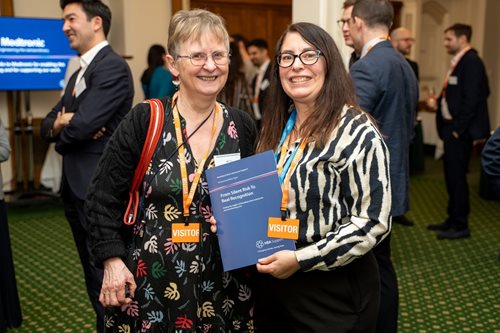
Photo of Krys and Nikki
"I joined the project because I enjoy using statistics to support organisations doing important work, particularly where good evidence can make a real difference to policy and patient care. I found it especially rewarding to help HBA Support develop a robust evidence base that could underpin their advocacy and communications. It has been a pleasure working with the team, and I'm delighted that the collaboration is continuing through new projects."
Krystyna Kelly, S4S Volunteer
S4S Volunteer: Krystyna Kelly
HBA Support lead: Nikki Davies