Talks to the LGC
1. October 19th, 2025, Peter Froggatt Centre, QUB.
Professor Anthony Davison, EPFL, Switzerland, gave a talk to the Local Group entitled:
Space Oddity? The Statistics of Conjunction Assessment
Professor Davison described the increase in objects in earth orbit in the last 35 years. In 1990 there were hardly any objects in orbit, by but 2025 there were more than 3500 objects in earth orbit (Figure below).
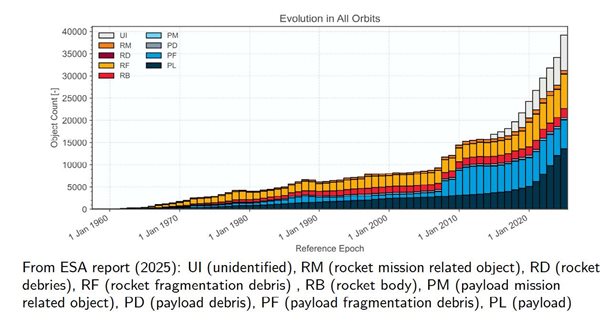
Given the wide range of orbits, - about 90 minutes to circle the Earth at ∼ 7 km/s – it is difficult to estimate positions of satellites and satellite operators look out for conjunctions, when two space objects approach within 5km of each other, whence they may need to take evasive action Accordingly, the increasing numbers of objects being launched pose a greater risk of collision.
Professor Davison explained the idea of a close conjunction; when one satellite closed on another thereby threatening collision. The data y, depends on the relative position and velocity vectors, involving parameters μ and ν respectively (each of 3 dimensions) and thus are modelled by a 6 dimensional multivariate normal distribution with a presumed known variance-covariance matrix Ω. Then the minimum distance between the two objects is ψ = ∥μ∥ cos β, where β ⸦ (π/2,3π/2). Switching then to polar co-ordinates allowed an orthogonal separation of ψ and a nuisance parameter λ.
Interest then focuses on ψ and he showed how engineers computed the probability of collision pc (technical details omitted), It turns out that this quantity is biased downwards and is correspondingly misleadingly small (too optimistic).
Anthony's team proposed an alternative Likelihood-based method focussing on ψ (in the conjunction plane) and using standard likelihood estimation methods. The proposed method worked well in simulation and also on a large set of modified NASA data which was used to compute the Miss Detection Rate (the fraction of Hits incorrectly classified as Misses) and the complementary False Alarm Rate (the fraction of Misses that are correctly classified as Misses) for different thresholds.
Anthony concluded by remarking that it was really no surprise that likelihood methods worked better than current engineering solutions. He added that one can also formulate a Bayesian approach he was working with NASA to see if the ideas elaborated above can be made operational.
This was a very accomplished talk, on an increasingly important topic, which was received with acclaim by a small, but appreciative, audience which thanked the speaker in the usual way.
Anthony then dealt with a number of questions about some of the assumptions made in the engineering solution (e.g., known Ω) and the progress being made persuading NASA's staff to adopt new methodology.
When the discussion ended, the Chair closed the meeting by thanking everyone for attending and noting that the next talk (November) would be on an application RJMCMC.
2. November 12th., QUB.
Emily Gribbin of the Department of Applied Mathematics, Queen's University, Belfast, gave a talk to the Local Group entitled:
Jumping to Conclusions: Reversible jump MCMC developed for change point detection in single molecule localisation microscopy
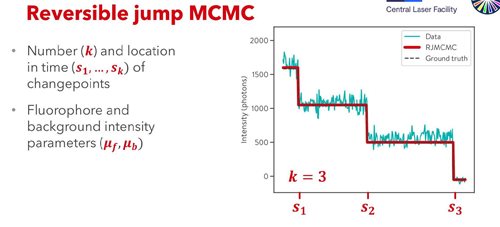 Emily Gribbin's talk dealt with detecting change-points in trajectories with values which declined in discrete stages ('states') over time. Some states were of very short duration ('blink') and some others were 'dark'. The objective was to model this process accurately determining the number and types of states present in a given trajectory (see adjacent Figure which omits blink and dark states). The number of states - measured between changepoints - correspond to the number of fluorophores present.
Emily spent a considerable portion of the talk explaining the scientific background in which mutations in EGFR proteins can cause changes in cell behaviour, including those leading to cancer. The spatial distribution of protein oligomers can provide insights into cancer development and super-resolution imaging allows observation of their distribution via the fluorophores (k=3 in the figure).
She first limited the standard RJMCMC protocol to: birthing, killing and shifting changepoints and then expanded the protocol to accommodate blink and dark states, modelling the intensity by a Gaussian distribution of the form : Y ~ N[μf ni + μb, σ2 f ni + σ2 b] where the μs are fluorophore and baseline intensities (respectively) and the σ2s are the corresponding variances. A final modification to the protocol accommodated pairs of adjacent blink states. She termed the final model a Compound RJMCMC model.
There were several competing methods (Factorial Hidden Markov Models, Monotonic Decay MAP, Sequential Filter MAP) and Emily used these as comparators in a simulation study which showed her CRJMCMC model to be best in class with the lowest MSE in all scenarios. The FHMM model took 10-12 times longer on average to complete and was not particularly good. She also applied her model to real data and discussed the clinical potential of the method including, inter alia, extracting better information from samples, supporting clinical translation, developing diagnostic tests and personalising treatment.
This talk was a tour de force, much appreciated by the audience who thanked the speaker in the usual way. There was a pause while the audience took stock. She was asked about the quality of the scientific support for the project and was able to re-assure the audience on this front. Of course, these were early days in the project and the clinical usefulness of the information recovered had yet to be established. The technical performance of her RJMCMC model was remarked upon.
Emily was thanked again and Chair thanked all of the participants for attending in person and reminded folk that Dr. Hannah Mitchell, QUB, would be speaking at our December meeting.
3. December 10th, Maths and Physics Teaching Centre, QUB.
Dr. Hannah Mitchell, gave a talk to the Local Group entitled:
Spatial Insights into Glaucoma Progression.
Dr. Mitchell opened by explaining the background. Glaucoma is a complex neurodegenerative disease affecting millions worldwide and leading to irreversible peripheral vision loss - “tunnel vision” (cf ., macular degeneration leading to loss of central vision). Progressive visual loss is caused by loss of retinal ganglion cells (RGCs). These are specialized neurons in the inner retina that transmit visual information to the brain via the optic nerve. However, due to the high plasticity of the central nervous system patients often don’t realise until late into the disease process. She then described spatial point process techniques and their application to glaucoma RGC data which enable the disease process to be studied at the cellular level.
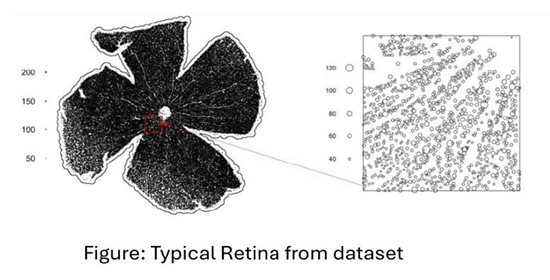 The data studied comprised 61 rat retina from 3 groups: (a) Control Group (15 retina), (b) Partial Optic Nerve Tran-section Procedure (pONT) group (24 retina) and the Ocular Hypertension (OHT) group (22 retina). In the pONT group retina were measured according as follows: 4 at 3 days, and in the OHT group 3, 5 at 7 days, 9 at 21 days, 4 at 56 days and 4 at 84 days. Each retina contains between 50,000 and 100,000 RGCs (see Figure showing a typical retina (Iris) and the data pattern observed in a small window near the centre of the Iris).
A stationary and isotropic spatial point process has intensity function given by λ (opposite), where |A| is the area of the region. 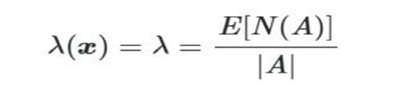
Hannah used first order intensity estimates of the process to analyse the pattern data and compare the groups illustrating the findings with coloured Iris figures which were not particularly persuasive. The data clearly did not conform to a completely spatially random process. She then turned to using summary statistics designed specifically for spatial processes (the F(.), G(.) and J(.) functions) and to Ripley's K statistics to study second order properties. However, it was not until Hannah adopted a statistical modelling approach that the results began to clarify.
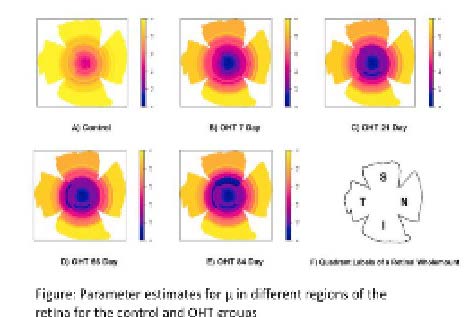 The model adopted, after considerable investigation was a variant of the Log Gaussian Cox Strauss Process (LGCPStrauss). This is a relatively novel model with a complicated likelihood and estimation of the parameters was by ABC. Hannah spent some time describing the intricacies of model before presenting the results in the accompanying figure which shows clearly the mean loss of central vision (purple) as one moves away from the control data shown in the first panel in the top row.
This was another tour de force demonstrating the power of statistical modelling to reveal underlying structure in what appeared, initially, to be a relatively unpromising set of data. The audience received this comprehensive talk with acclaim thanking the speaker in the usual way.
Hannah responded to some questions. On the use of an animal model she said these were early days and it had been important first to demonstrate that the statistical methods of analysis worked. How these methods might be applied in the clinical setting in humans was still being considered.
She was congratulated on the technical advances in the paper and asked about the use of the Log Gaussian Cox Strauss Process model. When the discussion concluded Hannah was thanked again.
Finally the Chairman thanked the audience for attending and wished everyone a Happy Christmas.
Professor Gilbert MacKenzie
March 15th, 2026.