Current William Guy Lecturers 2026-27
The theme for the coming academic year (1st August 2026 – 31st July 2027) is Statistics and Misinformation.
The William Guy Lectureship aims to inspire the next generation about the importance of statistics and data to understanding the world around us. This year we are highlighting the value of statistical thinking to combating misinformation, with our lecturers covering topics including misleading visuals, deepfakes, and social media algorithms.
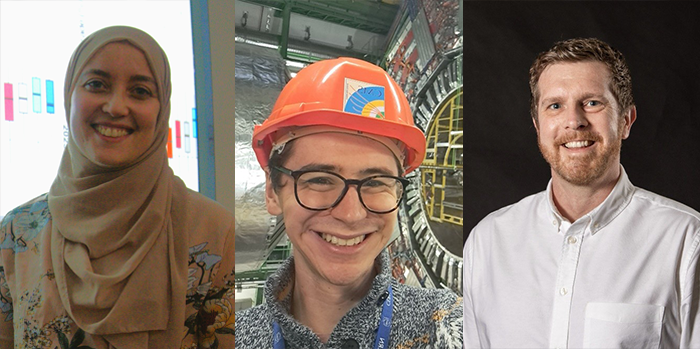
The 2026/27 RSS William Guy Lecturers are:
- Dr Takoua Jendoubi, Associate Professor in Statistical Data Science (Teaching) at University College London, and William Guy Lecturer for ages 11-14: Can you trust your feed? Deepfakes, algorithms, and the science and misinformation.
- Dr Jonathan Davies, Senior Statistical Officer at Department for Work and Pensions, and William Guy Lecturer for ages 15-16: Lies, damned lies, and statistics.
- Professor Tom Crick MBE, Chief Scientific Adviser at Department for Culture, Media and Sport, and Professor of Digital Society and Policy at University of Bristol, and William Guy Lecturer for ages 16+: Can you trust the numbers? Statistics, misinformation and the information ecosystem.
Takoua Jendoubi – William Guy Lecturer for ages 11–14
 About Takoua
Takoua is an Associate Professor in Statistical Data Science (Teaching) at University College London, working at the intersection of learning analytics, statistical methodology, and educational practice. She is Co-Director for Outreach of the RoSE (Researchers of Statistics Education) Network and Vice-Chair of the RSS Emerging Applications Section, where she actively fosters collaboration between researchers, educators, and practitioners in the statistical sciences. She is also a Fellow of the Higher Education Academy.
Her work focuses on developing evidence-based, inclusive approaches to teaching statistics and data science, with a particular emphasis on supporting students with limited prior experience in quantitative methods. She is especially interested in how learning analytics and behavioural data can be used to understand student engagement and inform more effective, equitable teaching strategies in higher education.
Takoua’s talk: Can you trust your feed? Deepfakes, algorithms, and the science and misinformation
Every day, you scroll past images and videos that look completely real—but what if some of them aren’t? In this talk, we explore two big questions: How can you tell if something is real or fake—and why do you keep seeing it?
First, we investigate how convincing fake content is created. You will discover how artificial intelligence can learn patterns from huge amounts of data—such as faces, voices, and movements—and use them to generate realistic images and videos, known as deepfakes. Through some examples, you’ll see why your eyes can be easily fooled and why “looking real” is no longer enough to prove something is true. Along the way, you will learn to think like a statistician—asking questions about evidence, uncertainty, and how likely something is to be genuine.
Next, we turn to social media and ask: why does the same kind of videos/images keep appearing in your feed? By simulating a recommendation system, you will explore how platforms decide what to show you based on what you click, watch, and like. You’ll uncover how this can create “filter bubbles,” where you see only a small slice of information, and how this can amplify misleading or fake content.
By the end of the session, you will have practical tools to question what you see, understand how it is produced, and recognise how algorithms shape your online world—I will show you simple tricks to spot fakes, think smarter, and stay one step ahead and safe online.
Jonathan Davies – William Guy Lecturer for ages 15–16
 About Jonathan
Jonathan is based in Manchester and currently works as a statistician in the UK Civil Service, specifically the Department for Work and Pensions (DWP). This involves collating, analysing, and presenting data related primarily to the benefits system to help ensure that decisions made by the government are based on accurate and robust information.
Prior to this role he worked in academia as a particle physics researcher at the world-famous Large Hadron Collider, studying the weird and wonderful world that exists at scales smaller than an atom to attempt to uncover some of the mysteries of the universe. This pursuit involved smashing together millions of protons a second at almost the speed of light and examining the mess that’s left behind.
Over the past few years, he’s enjoyed sharing his passion for science with the general public through a range of activities, and looks forward to doing a similar thing for statistics.
Jonathan’s talk: Lies, Damned Lies, and Statistics
We live in a world where information spreads faster than ever before. With billions of voices on the internet and social media, young people are surrounded by claims, charts, “facts”, and opinions — some reliable, many misleading, and some deliberately false. This talk will help students understand how statistical thinking can protect them from being misled, and how they can become more confident, critical users of information.
Using real-world examples, I introduce some of the most common ways in which statistics can be misunderstood or misrepresented, from selective reporting and misleading visualisations to sampling bias and over-interpreting limited evidence. We explore why uncertainty exists in everyday statistics — such as weather forecasts — and why “being wrong” doesn’t always mean “being useless.” Students will also learn about cognitive biases, including confirmation bias, that make us more likely to believe information that fits our existing views.
To illustrate these ideas, we look at cautionary tales such as the “millionaire dropout” myth and the famous story of rat culling in colonial Vietnam, showing how incomplete or poorly interpreted data can lead to bad decisions. Throughout, the focus is on giving students practical tools they can use in their own lives: how to question claims they see online, how to spot red flags in graphs or headlines, and how to think like a statistician when navigating the digital world.
The aim is simple: to empower students to become informed, thoughtful consumers of information — and less easy to fool.
Tom Crick – William Guy Lecturer for age 16+
 About Tom
Professor Tom Crick MBE is Chief Scientific Adviser at the UK Government’s Department for Culture, Media and Sport and Professor of Digital Society and Policy at the University of Bristol.
His work focuses on how data, evidence and technology shape society, culture and the economy, with particular interests in artificial intelligence, digital technologies, public trust, media and the integrity of the information ecosystem.
He advises on how evidence is used in public decision-making and how societies can develop the confidence and capability to navigate increasingly complex digital and data-driven systems. Tom is an experienced science communicator and public speaker, having worked with schools, teachers, policymakers and the wider public for more than 15 years. He has appeared regularly across television, radio and print media, and has led major science and technology curriculum reforms in Wales.
He is passionate about helping young people develop the statistical, digital and critical thinking skills needed to understand data, question information, and participate confidently in a good digital society.
Tom’s talk: Can you trust the numbers? Statistics, misinformation and the information ecosystem
Every day we encounter statistics in social media, news reports, political debates and discussions about health, climate change and new technologies. But how can we tell whether those numbers are helping us understand the world, or misleading us? This lecture explores how statistical thinking can help us navigate misinformation in a world where information spreads rapidly and trust in data, evidence and institutions matters.
Through real-world examples, we will look at how the same data can be presented in different ways, how graphs and statistics can sometimes mislead, and why understanding uncertainty, risk, complexity and bias is important. We will also explore how information travels through today’s digital world, including social media and AI-generated content, and discuss the difference between something that looks convincing and something that is genuinely trustworthy.
Along the way, we will consider how statistics form part of the information infrastructure through which citizens, communities and institutions understand complex issues and make decisions. The lecture will introduce a set of simple questions that anyone can use when they encounter a statistic, a graph or a headline.
By developing these practical skills, students will be better equipped to understand information, make informed decisions, and participate confidently in debates about the issues that affect society and the kind of digital future we want to build.